
Reclaim Systems Explained: When You Need One and How They Pay Off
November 10, 2026
If you pressure wash long enough, you eventually run into the same problem: the water has to go somewhere.
On a small residential driveway, that might not seem like a big deal. On a commercial property, parking garage, gas station, municipal sidewalk, or job near a storm drain, it becomes a completely different conversation.
That is where a reclaim system comes in.
A water reclaim system captures the wastewater coming off your cleaning surface, filters out dirt, debris, oil, and other contaminants, and either recycles the water or sends it somewhere it can legally be disposed of. For contractors, the question is not simply whether reclaim equipment works. The better question is whether your jobs justify carrying it.
For some contractors, a portable recovery setup is enough. For others, an integrated reclaim system can be the difference between being able to bid a job and having to turn it down.
In this blog article we will be discussing what a pressure washing reclaim system is, who needs it and how do you justify the cost.
What Is a Pressure Washing Reclaim System?
A reclaim system is essentially a way to control what happens to your wastewater after it leaves the surface you're cleaning.
The basic process is containment, capture, filtration, and reuse or disposal. You first keep the water from spreading with berms, a surface cleaner, or another containment method. A vacuum system then pulls the dirty water into a recovery tank. From there, the water passes through filtration and separation stages that remove solids, oil, and finer particles. The treated water can then be reused in the pressure washing system or disposed of through an approved method.
Mud Dog's Reclaim System uses a vacuum scupper to recover wastewater, followed by six stages of filtration capable of processing up to 8 GPM continuously through five-micron filtration. The system can return treated water to the bulk water tank for reuse on flatwork or divert it to landscaping or sewer where permitted.
That sounds straightforward, but the equipment behind it matters.
A reclaim system has to move wastewater quickly enough to keep up with the pressure washer. If you're producing water faster than you can recover it, the system isn't doing its job. An 8 GPM pressure washer paired with a recovery system that can only handle 5 GPM, for example, leaves roughly 3 gallons of water accumulating every minute unless you stop and catch up.
That's why reclaim should be treated as part of the overall trailer setup, not an accessory you add without considering your washer's flow, tank capacity, hose layout, and typical jobs.
When Do You Actually Need Reclaim?
This is the first question to answer before spending money on a system.
The rules vary by location, but the general principle is simple: you don't want dirty pressure washing wastewater flowing untreated into a storm drain or natural waterway.
That makes reclaim particularly important for jobs such as parking garages, schools, hospitals, municipal sidewalks, gas stations, industrial properties, and other large commercial surfaces.
Waterfront work deserves the same consideration. If you're cleaning near a creek, lake, beach, marina, or other sensitive area, you should assume that wastewater containment will matter until you've confirmed the local requirements.
The same applies when you're dealing with contaminants. Oil, grease, detergents, paint residue, and other substances change the equation. You are no longer dealing with water that simply needs to soak into the ground.
Then there are contracts.
A property manager or municipality may require a documented wastewater capture plan before they'll even consider your bid. In that situation, reclaiming equipment isn't just environmental protection. It's part of your ability to compete for the work.
Residential work is where things get more situational.
A small driveway in an open area may not require the same equipment as a commercial parking lot, particularly when local rules allow the water to remain on the property. But you still need to understand your local requirements.
The practical rule is this: if your wastewater can reach a storm drain or waterway, or if the customer or local authority requires containment, you need a recovery plan.
Portable Recovery vs. Trailer-Mounted Reclaim
There are a few ways to approach wastewater recovery, and the biggest mistake is assuming the biggest system is automatically the best system.
Portable vacuum units are generally the simplest option. They can work well for a one-man operation handling smaller, lower-flow jobs. That kind of setup can make sense when reclaim is something you only need occasionally.
For a contractor who primarily handles residential work, a compact trailer like the Mud Puppy can be a better starting point than a large commercial rig. It is a single-axle trailer with a 225-gallon tank and a 6 GPM hot-water system designed around one-gun operation.
That can make a lot of sense when reclaim is something you only need occasionally.
The trade-off is labor and capacity. Smaller recovery tanks need to be emptied more frequently, and the operator has more equipment to move and manage around the jobsite. If you're running a higher-flow pressure washer for hours at a time, a small portable recovery system can quickly become the bottleneck.
A trailer-mounted system takes the opposite approach.
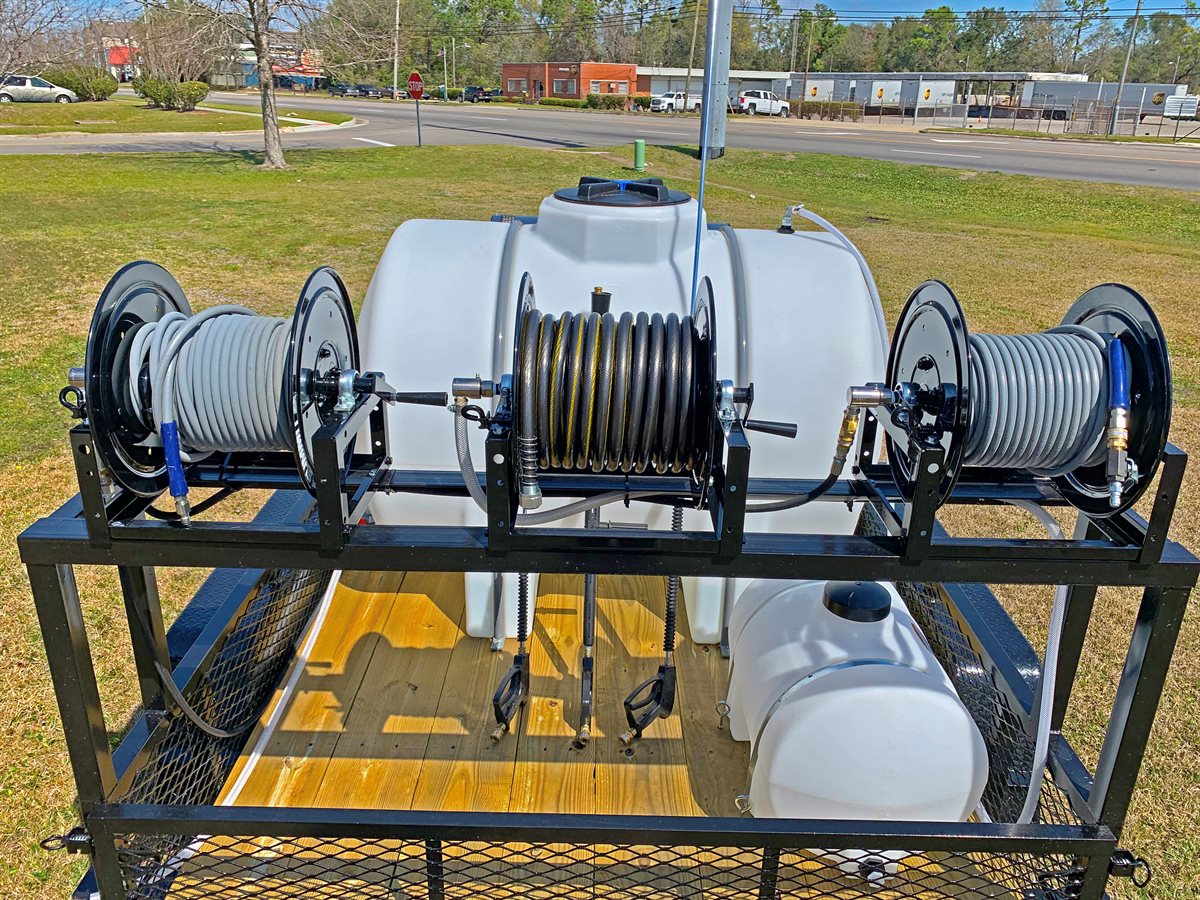
Instead of treating reclaim as something you bring along when needed, the recovery equipment becomes part of the pressure washing rig. The vacuum, holding tanks, filtration, pumps, and plumbing are integrated into the trailer.
Mud Dog's Reclaim System is custom-built because recovery requirements vary from contractor to contractor. It is designed for cold or hot water up to 200°F and is built around the customer's specific reclaim needs.
They cost considerably more, but you're buying more than filtration equipment, you're buying capacity and a workflow that is designed around continuous commercial work.
For a contractor doing large flatwork projects every week, having the recovery system already mounted, plumbed, and ready to deploy can eliminate a lot of setup and handling.
Why Flow Rate Matters More Than Most Contractors Think
Pressure washer GPM tells you how much water you're putting onto the surface. Reclaim capacity tells you how quickly you can take that water back off.
Those numbers need to work together.
If you're running an 8 GPM washer, an 8 GPM recovery setup gives you a much better starting point than something significantly below it. If your crew is running multiple guns or your recovery hoses have significant distance or lift, you may need additional capacity.
This is also why understanding your actual water consumption matters before you choose a trailer. Mud Dog's guide on how much water a pressure washer uses breaks down GPM, job duration, and tank sizing with real job examples. It also explains why your average job length and ability to refill should factor into the size of the water tank you carry.
Think about it in terms of production.
If your washer can continuously put out 8 gallons per minute but your recovery system can't keep up, you're eventually going to have to stop washing. The pressure washer isn't the limiting factor anymore. Wastewater recovery is.
For a growing commercial operation, that can become an expensive bottleneck.
Does Reclaim Save You Money?
Sometimes directly. Often indirectly.
The obvious savings comes from water reuse.
A reclaim system can recycle a large percentage of the water used during a job. That can reduce the amount of fresh water you need to bring to a site and make jobs possible in locations where water access is limited.
Mud Dog's water-use guide points out that even relatively ordinary jobs can consume hundreds of gallons. A driveway cleaned at 4 GPM for an hour uses about 240 gallons, while two hours of house washing at 3 GPM uses about 360 gallons.
Now multiply that across a high-volume commercial operation.
Depending on local water and wastewater costs, the direct dollar savings may or may not justify the equipment by themselves.
That's an important distinction.
If you're buying a reclaim system because you think you'll save a few dollars on municipal water every day, the math probably isn't compelling.
The bigger financial argument is what reclaim allows you to do.
Suppose a property manager has a $5,000 commercial cleaning project available, but the job requires wastewater recovery. If you don't have the equipment, you don't have a $5,000 job.
If you do, you can bid it.
That's where reclaim can start paying for itself.
The financial case also includes disposal costs, reduced water usage, and the ability to pursue contracts that require wastewater recovery.
In other words, don't calculate reclaim ROI based only on gallons of water saved.
Calculate it based on the jobs you can perform, the labor you eliminate, the water you reuse, the disposal you avoid, and the contracts you can now pursue.
Reclaim Can Make a Crew More Productive
There's another benefit that doesn't show up neatly on an equipment price tag: fewer interruptions.
On a large site, constantly dealing with wastewater can eat up time. If your crew has to stop washing, move hoses, empty recovery tanks, or figure out where the runoff is going, you're paying people to manage water instead of clean.
A properly sized integrated system can keep the process moving.
Mud Dog has also covered this broader relationship between trailer design and productivity in its article on 7 Reasons to Use a Pressure Washing Trailer Rig , including how integrated reclaim can reduce cleanup work and help commercial contractors operate more efficiently.
The goal isn't to make wastewater disappear. It's to make wastewater management predictable.
That said, reclaim isn't automatically faster.
You still have to deploy containment, position vacuum equipment, manage recovery hoses, monitor filters, and maintain the system.
That's why crew training matters.
A reclaim system sitting on a trailer doesn't make a crew efficient. A crew that knows exactly where the equipment goes, how the hoses are routed, when filters need attention, and how the recovery system works can turn that equipment into a real production advantage.
Which Pressure Washing Trailer Setup Makes Sense for You?
If you're a one-man contractor primarily cleaning residential homes, driveways, patios, and smaller flatwork, don't automatically convince yourself that you need the biggest reclaim trailer available.
A smaller trailer paired with portable recovery equipment may be enough, particularly if your local regulations allow simpler wastewater management on many of your jobs.
The Mud Puppy is a good example of that philosophy. Its compact single-axle design, 225-gallon water tank, and one-gun 6 GPM hot-water system are aimed at operators who value mobility and simplicity over maximum production capacity.
The equation changes when you're doing larger commercial work.
If you're regularly cleaning parking lots, garages, municipal properties, commercial buildings, fleet equipment, or other sites where wastewater capture is expected, an integrated reclaim system becomes much easier to justify.
That's where larger Mud Dog configurations such as the Original Mud Dog , 8GPM Super Mud Dog , Bulletproof Mud Dog , or Beast can make sense depending on your production requirements.
The important part is not buying the biggest trailer.
It's buying enough trailer to support the work you actually want to win.
Don't Forget About Maintenance
Reclaim systems are not maintenance-free.
You're moving dirty water through pumps, tanks, separators, and filters. Those components are going to see dirt, oil, grit, and debris.
Filters need to be replaced. Oil-absorbing media needs attention. Recovery tanks need to be cleaned. Vacuum seals and hoses need to be checked. The system needs to be maintained before a clogged filter or weak vacuum turns into a production problem.
That maintenance is part of the cost of doing business.
But compare it with the alternative. A recovery system that is maintained properly can keep a crew working. A neglected system can become another piece of equipment that slows everyone down.
The Bottom Line
A reclaim system isn't something every pressure washing contractor needs on every job.
But if you're moving into commercial work, working around storm drains or waterways, cleaning surfaces contaminated with oil or other pollutants, or bidding contracts that require wastewater recovery, it can quickly go from optional equipment to necessary equipment.
The right setup depends on your flow rate, job types, crew size, water requirements, trailer capacity, and local regulations.
For smaller operators, portable recovery can provide the protection and flexibility you need without adding the cost and weight of a full integrated system.
For contractors running higher-flow hot-water equipment and pursuing larger commercial contracts, an integrated reclaim trailer can make much more sense. It gives you the recovery capacity to keep up with the washer, the water capacity to stay productive, and the equipment needed to handle wastewater as part of a repeatable jobsite process.
The best way to look at reclaim is not as another expensive accessory.
Look at it as part of your production system.
If it helps you work faster, reduce water and disposal costs, avoid compliance problems, and bid work that you couldn't take before, it can earn its place on the trailer.
If your current work doesn't require that capability, spending tens of thousands of dollars on reclaim equipment may not be the smartest move yet.
Know what your jobs demand, then build the trailer around those demands.
If you're trying to figure out which setup makes sense for your operation, start with Mud Dog's complete trailer lineup , take a look at the Mud Dog Reclaim System , or contact the Mud Dog team with questions about a custom setup. The goal isn't to put more trailer under you than you need. It's to make sure the equipment you buy actually fits the work you're trying to do.